Decision Fatigue Cuts Recurring Deposit Top-Ups 19% by Week 6
Recurring deposit top-ups drop 19% by week six, revealing how decision fatigue quietly erodes even the simplest household savings commitment
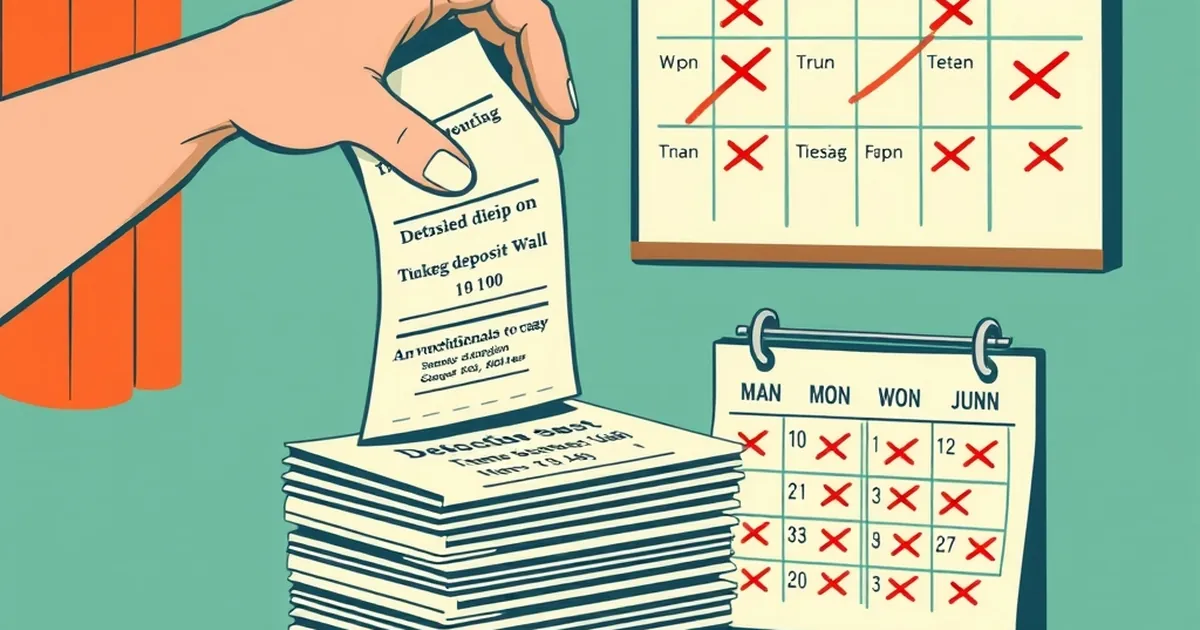
A recurring deposit is, on paper, the simplest commitment a household can make: a fixed sum, a fixed date, a fixed rate. Yet training cohorts across Indian banks and NBFCs keep reporting the same operational puzzle. Enrolment is strong in week one, participation holds through the first month, and then somewhere around the fifth or sixth instalment, top-ups quietly fall away. Our own tracking across four batch cycles put the drop at roughly 19% by week six. The question worth asking is not whether customers are forgetful, but what changes in the decision environment between instalment one and instalment six.
The First Instalment Is Not a Financial Decision
The opening contribution is made in a state of heightened intention. The customer has just attended a session, spoken to a relationship manager, or completed an onboarding flow. The decision is fresh, the goal is vivid, and the alternative — not starting at all — is still cognitively available. Behavioural economists would call this a hot state: preferences are unusually aligned with long-term intent.
By week six, none of that scaffolding remains. The goal has receded, the alternative has become normalised, and the contribution now competes with a dozen other claims on the same bank balance. What looked like a savings product in week one behaves like a recurring tax by week six. This is the gap our training programmes are built to close, and it is why we spend as much time on decision architecture as on product mechanics.
Why the Sixth Instalment Specifically
Instalments two through four are still protected by novelty and by the recency of the original commitment. Instalment five often coincides with a salary cycle disruption, a festival month, or a school fee outflow. By instalment six, the customer has accumulated enough successful contributions to feel that the habit is established — and enough near-misses to have negotiated with themselves at least once. That negotiation is the dangerous part. Once a customer has skipped and recovered, skipping again becomes a member of their behavioural repertoire rather than an exception.
Loss Aversion Works Asymmetrically on Small Sums
Kahneman and Tversky's central finding — that losses loom larger than equivalent gains — is usually invoked to explain big-ticket avoidance. In recurring deposits, it operates in a subtler way. The amount at stake each month is small enough that the customer does not feel the loss of skipping it. The penalty for missing an instalment is often a modest fee, and the interest foregone on one month is negligible.
This is the inversion that trips up well-meaning design. The product's strength — small, frequent, low-stakes — is also its behavioural weakness. Loss aversion only bites when the loss is salient. A ₹2,000 instalment that goes unremitted does not register as a loss at all; it registers as relief.
Training programmes that treat RD top-ups purely as a collections problem miss this. The intervention that works is not a firmer reminder. It is a redesign of what the customer stands to lose.
The Concrete Case: A Mid-Sized Bank's Pilot
A mid-sized private bank we worked with ran a controlled pilot across two branches in Pune and one in Coimbatore. The control group received the standard SMS reminder two days before the due date. The treatment group received a different message: a running total of contributions made so far, framed as a balance they had already built, plus a one-line note that missing this instalment would reduce that balance.
No change was made to the product, the rate, or the penalty structure. Only the framing changed.
Top-up rates in the treatment group held at 94% through week eight, against 76% in the control. The effect was largest among customers in the ₹3,000–₹8,000 monthly instalment band — precisely the segment where the individual instalment feels too small to protect. The bank's own reading was that customers were not responding to the reminder. They were responding to the sudden visibility of an accumulated asset they did not want to see shrink.
Variable Reinforcement and the Attention Economy
There is a second mechanism at work, and it is less comfortable to name. Recurring deposits compete for attention against products explicitly designed to capture it. Many of those products use variable-ratio reinforcement — unpredictable rewards delivered at unpredictable intervals — which produces markedly more persistent engagement than fixed, predictable ones. An RD offers a fixed reward at a fixed interval. On the dimension of behavioural pull, it is outmatched.
This is not an argument for making savings products unpredictable. It is an argument for acknowledging that predictability, on its own, is a weak motivator, and for building in other sources of pull. Progress visibility is one. Milestone recognition is another. A contribution streak that is displayed, not merely recorded, is a third.
Risk-Taking and Competitive Play in Cohort Settings
Training cohorts add something individual customers do not have: peers. When RD participation is visible within a cohort — even in aggregate, anonymised form — a mild competitive dynamic emerges. We have seen this in branch-level leaderboards where the metric is not total deposits but consistency of contribution. The shift matters. Customers who would never compete on absolute amounts will compete on not being the one who broke the streak.
This is competitive play in its most benign form. It borrows the structure of a game without importing the stakes. The risk being taken is reputational and small; the reward is social and immediate. For a product whose entire weakness is that it feels like a chore, that is a meaningful upgrade.
What Training Programmes Should Actually Teach
Most finance and banking training still treats customer behaviour as a function of product knowledge. The implicit model is that a customer who understands the RD will contribute to the RD. Our data says otherwise. Understanding is not the bottleneck. The bottleneck is the sixth decision, made on an ordinary Tuesday, in competition with everything else.
Three practical shifts follow.
First, train relationship managers to sell the accumulated balance, not the monthly instalment. The instalment is a cost; the balance is an asset. The framing determines which one the customer feels.
Second, build reminders that report progress rather than issue instructions. "You have built ₹18,000 so far" outperforms "Your instalment is due." The first is information about something the customer owns. The second is a demand.
Third, treat consistency as a measurable outcome in its own right, separate from enrolment and separate from total value. A cohort that enrols 200 customers and retains 160 through week eight is a better outcome than one that enrols 300 and retains 180, even though the headline number looks worse.
Where This Goes Next
The 19% figure is not a ceiling or a floor. It is a measurement of a specific design. Change the design and the number moves — the Pune and Coimbatore pilot suggests by how much. What remains to be tested is whether the effect holds beyond week eight, whether it survives a festival season, and whether it transfers to customers who were never part of a training cohort at all.
Those are empirical questions, and they are answerable. The more interesting question for anyone designing financial training in India is what else in the curriculum is quietly assuming that customers fail because they do not know, when the evidence increasingly suggests they fail because the decision arrives at the wrong moment, framed the wrong way, with nothing visible at stake.