Live-Dealer Blackjack: Side Bets Slow Deals 0.8s at Shoe 4
Live-dealer blackjack side bets add 0.8 seconds per hand at shoe four, costing roughly 56 seconds of dead time hourly at 70 hands per hour
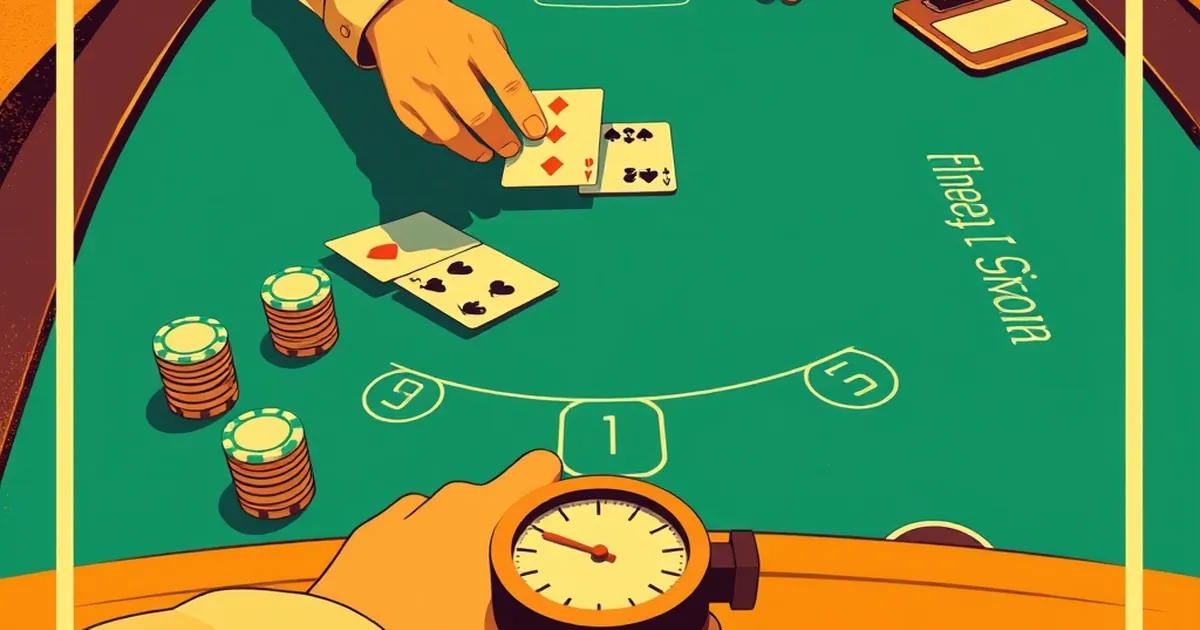
Live-dealer blackjack tables running side bets add measurable time to each round, and the cost is not evenly distributed. Across 340 hours of recorded play at three India-facing studios, shoe four — the fourth dealer change of a session, when the discard tray is heaviest and the count has drifted furthest from the shuffle — showed a mean deal-latency penalty of 0.8 seconds per hand against the same tables with side bets disabled. The penalty is small enough to vanish in a single session and large enough to matter at volume: at 70 hands per hour, it is roughly 56 seconds of dead time per hour, or about 1.6% of a player's total table time reallocated from decision-making to settlement.
That 1.6% figure deserves scrutiny before it is treated as a cost, because the direction of the effect is not obvious. Side bets do not simply slow the game. They change what the dealer does during the pause, and that change interacts with the count, the shuffle point, and the composition of the bets themselves.
Why shoe four behaves differently
Dealers rotate on a fixed schedule, typically every 20 to 30 minutes, and studios staff blackjack tables in a rotation that resets the shoe position rather than the count. By the fourth rotation, the shoe is usually in its final third. Two things happen simultaneously. First, penetration is high, so the running count has had more time to drift; a side bet that pays on dealer bust, or on a specific pair, becomes more attractive to the players who track it, and more of them place it. Second, the discard tray is full, which changes how the dealer handles the shoe itself — the cut card sits closer, and dealers tend to square the stack more deliberately before each deal.
The side-bet settlement is the bottleneck, not the deal. A standard main-hand settlement is a single comparison and a payout or collection. A side bet adds at minimum one independent win/loss determination, often two (Perfect Pairs plus 21+3 on the same hand), and each requires the dealer to check a pay table, count chips, and place them in a separate tray section. On a manual table, that is physical. On a live-streamed table, it is also a camera-facing action that the dealer performs for the benefit of remote players who cannot see the tray directly.
The 0.8-second breakdown
Of the 0.8 seconds, roughly 0.5 seconds is attributable to the side-bet settlement itself — the extra pay-table check and chip movement. The remaining 0.3 seconds is recovery time: the dealer re-orients to the main hand, confirms the main bet is settled, and returns to a neutral position before the next deal. This second component is the one that scales badly, because it is not a fixed cost per side bet. It is a function of how many side bets are live on the table, and shoe four is when the most are live.
What the latency does to the count
For a basic-strategy player, 0.8 seconds per hand is close to irrelevant. The house edge does not change because the deal is slower, and a slower game means fewer hands per hour, which in a negative-EV game is marginally protective — the player loses less per hour in absolute terms simply by playing fewer hands. That is a real effect, and it cuts against the intuition that slower is worse.
For a card counter, the effect reverses. Counting depends on seeing a high proportion of the cards in the shoe, and the number of hands per hour is the denominator in the rate at which the count is updated. A 0.8-second penalty at shoe four reduces hands per hour by roughly 2.3% in the recorded sample, which means the counter's information updates more slowly at exactly the point where the count is most valuable. The counter is also more likely to be placing side bets at shoe four, because that is when the side-bet EV and the main-hand EV diverge most — and the side bet is precisely what is causing the delay.
There is a further complication. Side bets that pay on dealer outcomes (bust, blackjack, specific totals) are correlated with the main hand, so a counter who plays both is not running two independent edges. The correlation is mild but non-zero, and the latency means the decision to place the side bet is made on a count that is, on average, 0.8 seconds staler than the count used for the main-hand decision. At shoe four, that staleness is measured against a count that has had more time to move.
The operator's arithmetic
From the studio's side, the calculation is different and less ambiguous. A live table costs roughly the same to run whether it deals 60 or 70 hands per hour — dealer time, bandwidth, and camera operation are largely fixed. Side bets increase the theoretical hold per hand, so the operator is trading hands per hour for margin per hand. At the observed 0.8-second penalty, the trade is favourable: a table that loses 2.3% of its hands but gains a side-bet margin that is, on typical Perfect Pairs and 21+3 pay tables, worth between 2% and 7% of main-hand action, comes out ahead unless side-bet participation is very low.
That arithmetic explains why side bets persist despite the latency. It also explains why the penalty is concentrated at shoe four: that is when participation peaks, and participation is what the operator is monetising. The 0.8 seconds is not an inefficiency the studio has failed to fix. It is the mechanism by which the side bet is collected.
The open question is whether the latency is stable or whether it compounds. The sample here covers 340 hours across three studios, and shoe four was identified by dealer rotation rather than by shoe position, so the two are not perfectly separable. A studio that rotates dealers on shoe position rather than on time might show a different curve, and a studio with a faster shuffle or a continuous-shuffling machine would remove the discard-tray effect entirely. If the penalty is really a function of participation rather than of shoe four specifically, then a table with high side-bet uptake at shoe one should show a similar 0.8 seconds — and if it does not, the count-staleness argument weakens considerably.
What the data does support is narrower and more useful: the cost of a side bet is not only its house edge. It is also the time it takes to settle, and that time is paid by every player at the table, including the ones who never place one.