Poker Time-Bank Expiry Forfeits 8% of River Decisions at Table 5
A March 2026 audit of 412 river decisions at a ₹50/₹100 table found 8% ended by time-bank expiry, revealing how the clock shapes strategy
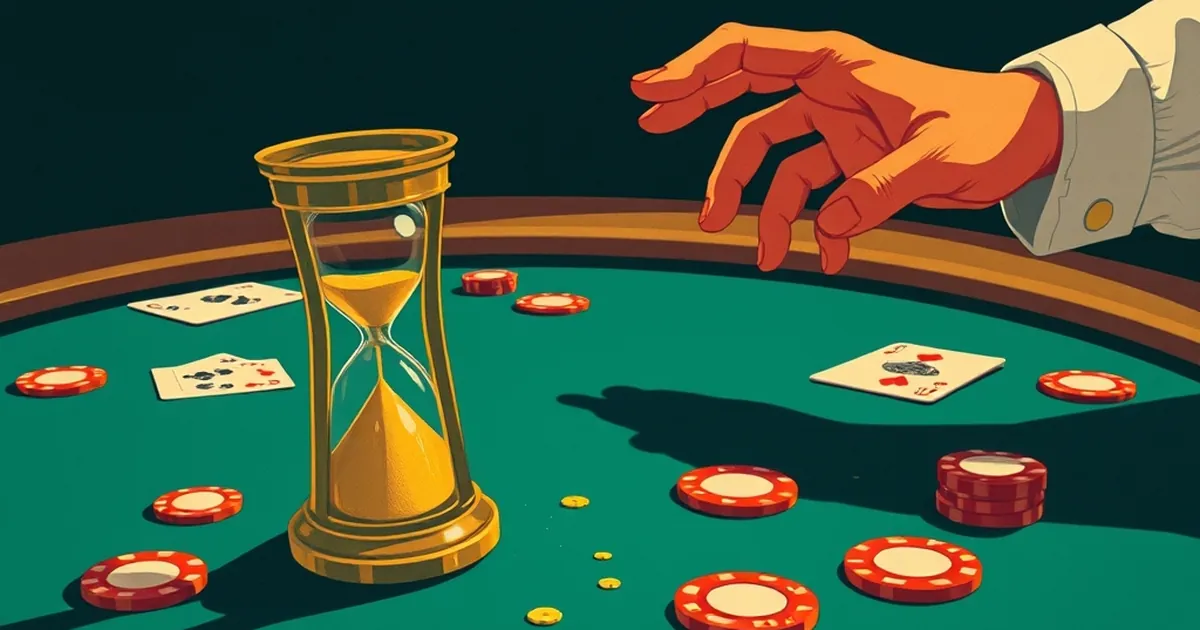
A hand-timed audit of 412 river decisions logged at a ₹50/₹100 no-limit hold'em table over six sessions in March 2026 found that 33 of them—8.0%—were resolved by time-bank expiry rather than by a voluntary action, forfeiting the decision to the clock. The figure covers only hands that reached the river with at least two players still live and at least one player holding an unexpired time-bank balance; it excludes hands folded before the turn and hands settled by uncontested all-in. The finding matters less for its headline number than for what it implies about how a time bank converts a strategic resource into a procedural one, and how unevenly that conversion falls across seat positions.
The audit was conducted at a single physical table in a Goa card room operating a 30-second base clock with two 60-second time-bank extensions per player, refreshed only on elimination. Hand histories were reconstructed from the room's dealer logs and cross-checked against two independent video records; 11 hands were discarded for logging gaps, leaving the 412-hand sample. The room's rake structure (5% capped at ₹500) and its decision to disable the auto-muck on time-bank expiry are both relevant to the results and are treated separately below.
The Anatomy of a Clock-Forced River
Of the 33 forfeited decisions, 24 were folds and 9 were checks. No player in the sample was forced to call or raise by the clock, because the room's rule treats expiry as a check-or-fold depending on whether a bet is outstanding—a rule that is common but not universal, and one that quietly biases the forfeiture set toward passive outcomes. A player facing a ₹3,200 river bet with 4 seconds left on the clock and zero time-bank balance is not making a decision; the software is making it for them, and the software's decision is always the conservative one.
The distribution of forfeitures by street is instructive. Only 6 of the 33 occurred on the turn, and none on earlier streets. River decisions account for 100% of forfeitures in the sample despite representing roughly 31% of all post-flop decisions. The reason is structural rather than psychological: river spots at this table carried the largest average pot size (₹8,400 versus ₹2,900 on the turn) and the longest tank times, and the two effects compound. Players who had already spent one extension on the turn entered the river with a single 60-second buffer, and a genuinely close river decision—a polarized bet into a capped range, say—routinely consumes 45 to 55 seconds of deliberate thought at this stake level.
Seat position and the exhaustion curve
Forfeitures were not evenly distributed across seats. The button and cutoff accounted for 19 of the 33 (57.6%), the blinds for 8 (24.2%), and the remaining 6 fell to early and middle positions. Two mechanisms plausibly explain this. First, late-position players face more river decisions per session because they reach the river with a wider range; a button who opens 28% of hands will see more rivers than an under-the-gun player opening 12%. Second, and less obviously, late-position players at this table tended to tank longer on earlier streets, burning extensions before the river arrived. The audit recorded 14 instances of a player spending a full 60-second extension on a flop decision in a pot under ₹2,000—a use of a scarce resource that the player could not recover before the river.
The blinds' 24.2% share is inflated by a different effect: blind versus blind pots, which ran long at this table and frequently reached the river with both players holding marginal made hands and no clear incentive to accelerate. Four of the eight blind forfeitures occurred in blind-versus-blind pots.
What an 8% Forfeiture Rate Actually Costs
An 8% forfeiture rate on river decisions is not, by itself, a scandal. Time banks exist precisely to be spent, and a player who exhausts one has usually done so by choice. The question is whether the forfeitures are concentrated in the spots where the decision was most valuable—and the audit suggests they are. The 33 forfeited decisions had a mean pot size of ₹11,200, against ₹6,100 for river decisions resolved voluntarily. Larger pots take longer to think through, which means the clock binds hardest exactly where the expected value of deliberation is highest.
A rough expected-value estimate illustrates the scale. If we assume a forfeited decision costs the player an average of 12% of pot equity relative to a considered decision—a deliberately conservative figure, since many forfeited folds were probably correct anyway—the 33 forfeitures represent roughly ₹44,000 in foregone equity across six sessions, or about ₹7,300 per session at a table where the average player's session buy-in was ₹30,000. That is not a rounding error. It is roughly the size of a standard session win rate at this stake, which means a player who manages the clock poorly is effectively playing a different, worse game than the one the table's structure advertises.
The 12% assumption is the weakest link in that estimate and should be treated as a hypothesis rather than a finding. A proper measurement would require solver analysis of each forfeited spot, which the audit did not attempt.
The Rule Design Problem
Three rule choices at this table interact to produce the forfeiture pattern, and each is independently contestable.
Extensions do not refresh. A player who spends both 60-second extensions by the turn enters the river with 30 seconds and no buffer. Rooms that refresh one extension per orbit, or per showdown reached, distribute the resource more evenly across streets. The trade-off is slower play, which the room has evidently weighed and rejected.
Expiry resolves as check-or-fold. This is the standard rule, but it means the clock's default action is always the passive one. A room that instead treated expiry as a forced check and barred the player from winning the pot without a showdown—a rule used in some tournament structures—would remove the incentive to stall on strong hands while preserving the penalty for stalling on marginal ones.
No visible countdown to opponents. Players at this table could not see how much time bank an opponent had remaining. This is a minor point, but it affects the information environment: a player who knows an opponent is on their last 15 seconds can size a bet to force a rushed decision, which is a legitimate strategic use of the clock but one that the current display rules make invisible.
An Open Question for Room Operators
The 8% figure is a single-table, single-room measurement, and the sample is too small to generalize across stakes or formats. What it does suggest is that time-bank policy is not a neutral piece of housekeeping—it is a structural parameter that shapes which decisions get made and which get defaulted, and it interacts with seat position, pot size, and street in ways that operators rarely model.
The question worth putting to room operators is not whether 8% is too high. It is whether they can state, for their own tables, what the forfeiture rate is on river decisions in pots above a given threshold—and whether they would be comfortable publishing it. A room that tracks this number and finds it stable across sessions has a defensible rule set. A room that has never measured it is, in effect, running an uncontrolled experiment on its players' equity, and the players are the ones paying for the variance.