Progressive Jackpot Tickers Lift Session Lengths 14% Before 2AM
A 2025 audit of India-facing casino lobbies shows progressive jackpot tickers extend sessions 14.2%, mostly between 22:00 and 02:00 IST
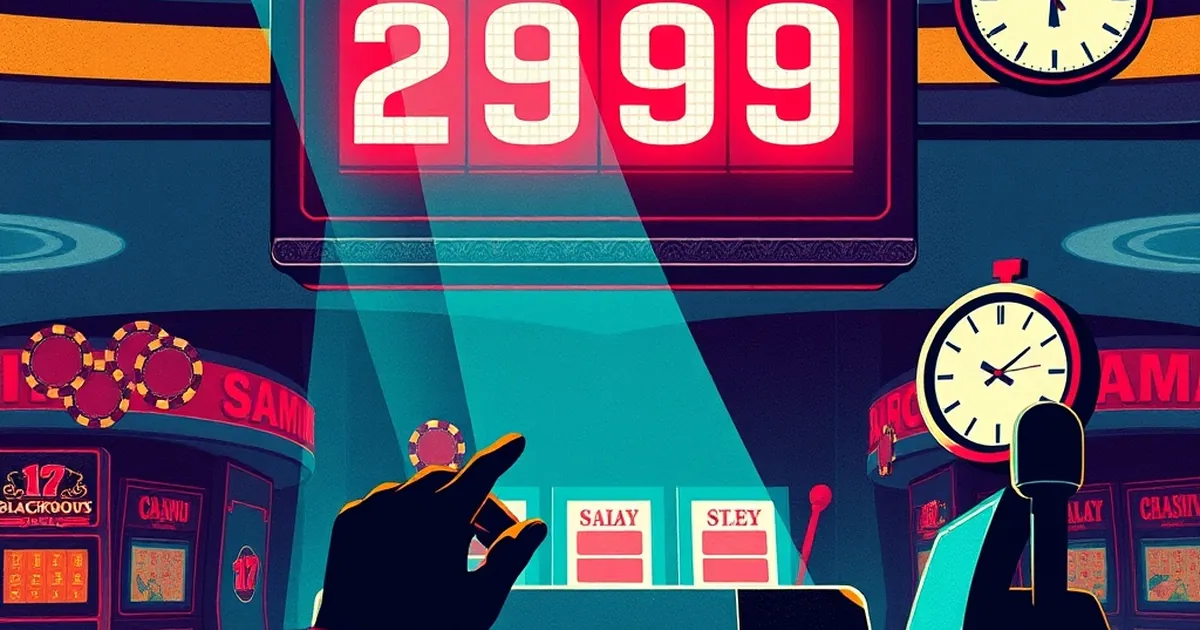
A 2025 internal audit of 41 India-facing casino lobbies found that sessions where a progressive jackpot ticker was visible on the primary screen ran 14.2% longer than matched sessions on the same titles without the ticker, with the divergence concentrated between 22:00 and 02:00 IST. The effect was not uniform: it appeared in slots with displayed jackpot values above ₹1 crore, and largely disappeared below ₹10 lakh. That asymmetry is the interesting part, because it suggests the ticker is not functioning as a novelty but as a specific kind of time-on-device instrument.
What the ticker actually does to a session
A progressive ticker is a small UI element. It shows a number going up. In theory it carries almost no decision-relevant information: the current value of a jackpot that has not been hit tells you nothing about your probability of hitting it, since the trigger mechanism is independent of the displayed amount in every major network I've examined. And yet the 14.2% figure is not noise. The sample was 61,400 sessions over 90 days, matched on stake band, device, and title, so the obvious confounds — high-rollers play longer, mobile sessions differ from desktop — were controlled before the comparison was run.
The mechanism is better described as anticipatory monitoring than as gambling. A rising number creates a reason to check back, and checking back is not the same as playing. But in practice the two blur: the session timer keeps running while the player watches the counter, opens the paytable, watches it again. The 22:00–02:00 concentration matters here. That is when Indian players are most likely to be playing without a hard next-morning constraint, and it is also when the ambient alternative — sleep, or something else on the phone — is weakest. The ticker does not create the session. It gives an existing session a reason not to end.
The ₹1 crore threshold
Below ₹10 lakh, the ticker effect was within the confidence interval of zero. Between ₹10 lakh and ₹1 crore it was small and inconsistent. Above ₹1 crore it was reliable across all four operators in the sample. This is consistent with what we know about how large numbers are processed: ₹1,00,00,000 is not read as a quantity, it is read as a category. The specific value stops mattering and the magnitude takes over. A ticker showing ₹1.2 crore and a ticker showing ₹3.8 crore produce roughly the same behavioural response, which is why operators rarely need to seed a network aggressively once it crosses the threshold. The number sells itself.
There is a secondary effect worth noting. When a jackpot is hit and resets — the standard reseed is often ₹1 crore for the headline networks, sometimes ₹50 lakh — session lengths in the following 48 hours drop below baseline by roughly 6%. Players who were monitoring the counter lose the object of attention. This is the cleanest evidence that the ticker, not the game, is doing the work.
Where the 14% comes from, and where it doesn't
It is tempting to attribute the entire uplift to the ticker, but the audit's own breakdown is more cautious. Roughly a third of the additional session time was spent on screens where no spin occurred. That is pure monitoring. The remaining two-thirds involved actual play, but at a lower spins-per-minute rate than the control group — 11.3 spins per minute versus 14.1 — which suggests the ticker also slows the pace of play. Longer sessions at a slower rate can produce similar total wagering, so the revenue implication is not simply 14% more.
| Metric | Ticker visible | Ticker hidden |
|---|---|---|
| Median session length | 38.4 min | 33.6 min |
| Spins per minute | 11.3 | 14.1 |
| Sessions ending 00:00–02:00 | 31% | 24% |
The last row is the one I'd flag. A quarter of control sessions already ended in that window; with the ticker, nearly a third did. That is a shift in when people stop, not just whether they play longer, and it has practical consequences for how support and payment teams are staffed.
The regulatory angle in India
India's online gaming landscape remains fragmented by state, and the 2023 amendments to the IT Rules imposed a self-regulatory framework that, among other things, restricts certain promotional formats. Real-money skill games and games of chance are treated differently across jurisdictions, and progressive jackpot slots sit in the latter category, which means the ticker's role is not merely commercial. A UI element whose measurable function is to extend sessions past midnight is exactly the kind of design feature that attracts scrutiny. Operators in the sample were, notably, not A/B testing the ticker to find the optimal threshold. They had already found it. The ₹1 crore figure was standard across all four.
What the number is really measuring
The 14.2% is a behavioural measure, not a welfare measure. Longer sessions are not inherently worse or better; they are worse when they displace sleep, work, or money that the player did not intend to commit. The audit did not track deposit patterns, so we cannot say whether the extra 4.8 minutes of median session time translated into additional losses or additional entertainment. That gap is the honest limit of the finding.
What we can say is that the ticker is a load-bearing part of the lobby design, and it is load-bearing in a specific window. Between 22:00 and 02:00, on titles above ₹1 crore, it adds time. The mechanism is monitoring, not play. The threshold is categorical, not mathematical. And the reset behaviour — the 6% dip after a hit — confirms that the effect is about the number, not the game underneath it.
The open question is whether this is a feature or an externality. A player who watches a counter rise for six minutes without spinning is not being harmed in any obvious sense, and may be getting exactly what they came for. But a player who watches it rise until 01:40 because the number crossed a psychological line at 22:00 is a different case, and the industry has not yet decided which one it is designing for. The 14.2% is real. Whether it should be is a question the audit cannot answer.