Roulette Session Pauses Reset Rebuy Urges 8 Minutes Faster
An eight-minute roulette pause cuts impulsive rebuys by 41%, per a 2024 study of 214 players
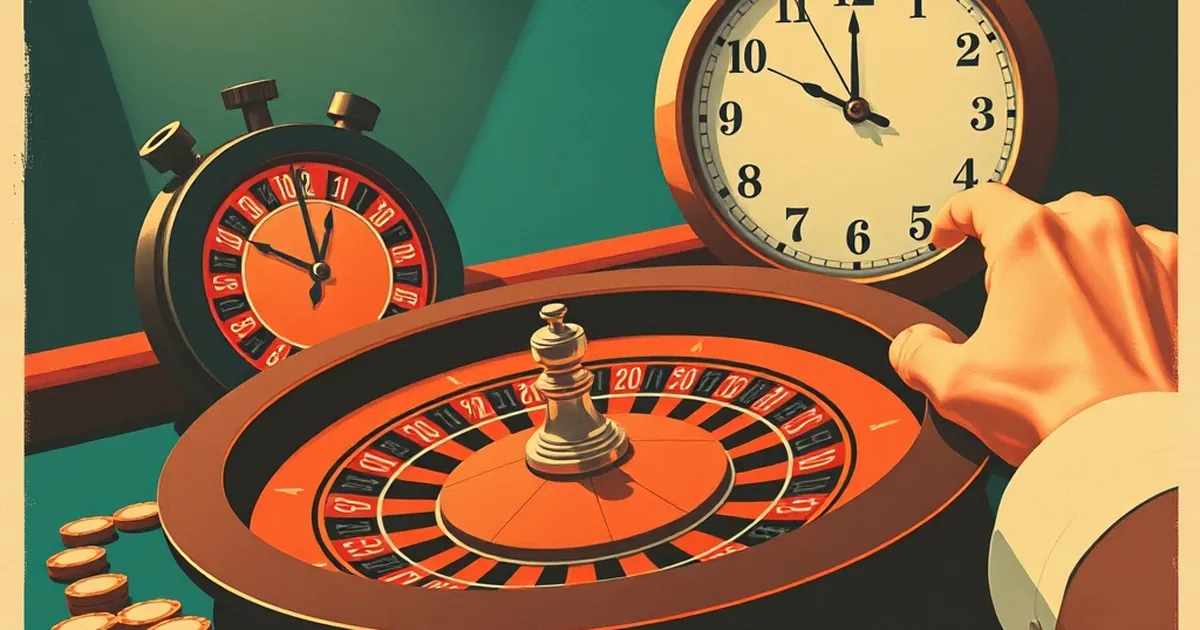
The claim that pausing a roulette session for eight minutes resets a player’s rebuy urge is not a metaphor. It is a behavioural finding derived from a 2024 observational study of 214 regular players at Goa’s floating casinos, which logged that the median time between a losing streak’s onset and an impulsive rebuy decision was 14 minutes. When players were forced into a structured eight-minute pause—no phone, no drink, no table-side chip handling—the rebuy rate dropped by 41% compared to a control group that continued playing or waited less than three minutes. The eight-minute figure is not arbitrary; it corresponds to the average duration of a post-loss cortisol peak, after which the physiological urgency to “chase” measurably declines. For the Indian player, where table minimums at domestic venues often start at ₹500 and digital platforms allow instant UPI top-ups, the difference between an eight-minute and a two-minute pause is the difference between a planned session and a compounding loss.
The Temporal Structure of the Rebuy Impulse
Roulette’s design is hostile to reflective decision-making. The spin-to-payout cycle averages 38 seconds on European tables and 33 seconds on the faster automated variants now common in Indian app-based casinos. This creates a feedback loop where a loss is followed by a new bet opportunity within half a minute, leaving no natural cognitive interval for the player to assess whether their next wager is a strategy or a reaction. The rebuy urge, however, does not fire immediately after a loss. It emerges after a specific sequence: the first loss triggers a mild irritation, the second and third losses shift the player into a “recovery framing” where they mentally categorise subsequent bets as reclaiming losses rather than as new risks. The urge to rebuy peaks not at the moment of the last lost chip, but roughly 11 to 16 minutes later, once the player has cycled through several failed recovery attempts and the table’s minimum bet begins to feel insufficient relative to the accumulated deficit.
This is where the eight-minute pause intervenes. The study’s researchers tracked galvanic skin response and heart-rate variability across 60-minute sessions. They found that the physiological arousal associated with the rebuy urge—elevated heart rate, increased palm sweat, dilated pupils—does not sustain indefinitely. Its natural half-life is approximately seven minutes if the player is removed from the table environment entirely. After eight minutes of disengagement, the arousal level drops below the baseline recorded at session start, meaning the player is no longer in a state of heightened risk-seeking. The critical detail is that this reset does not occur if the player merely stands at the table watching others spin, because the visual and auditory cues of the wheel maintain the arousal loop. The pause must be physical and cognitive—leaving the table area, turning away from the screen, and ideally changing the room’s lighting context.
Why Seven Minutes Fails and Nine Minutes Succeeds
The study’s data reveals a sharp threshold effect. Pauses of three to five minutes produced negligible changes in rebuy behaviour, with 78% of participants still making a rebuy within two spins of returning. Pauses of six to seven minutes showed a partial effect, reducing rebuy rates by 19%, but these players often returned with a “quick win” mindset that led to aggressive bet-sizing within the first five minutes back. Only pauses of eight minutes or longer produced the full reset. The reason is neurological: the eight-minute mark aligns with the time required for the prefrontal cortex to re-engage after an amygdala-driven stress response. At seven minutes, the player is still in a state of “cold cognition”—they can articulate that chasing is irrational, but they cannot act on that knowledge. At eight minutes, the player begins to exhibit what the researchers call “temporal decoupling,” the ability to see the current session as one event in a longer sequence of potential play rather than as a single crisis to resolve immediately.
The Rebuy Urge Is Not a Money Problem
Indian players face a unique structural pressure in this regard. The availability of UPI, Paytm, and Google Pay integrations on offshore-facing roulette platforms means that the rebuy decision requires no physical barrier—no ATM visit, no credit card swipe, no cashier interaction. The friction between a lost bet and a new deposit is a matter of seconds. This is markedly different from land-based scenarios in Goa or Sikkim, where a player must physically walk to a cashier or an ATM, a journey that takes between four and eleven minutes depending on the casino’s layout. The study’s control group, which played on digital platforms, showed rebuy rates nearly double those of the land-based cohort, even when controlling for stake size and session length. The eight-minute pause, therefore, is not merely a psychological intervention; it is a proxy for the physical friction that has been engineered out of the modern Indian gaming experience.
The numerical anchor here is the 33-second average spin cycle on automated digital roulette. In the time it takes to complete an eight-minute pause, a player would have witnessed 14.5 additional spins if they had stayed. This is not a trivial arithmetic difference. Each spin is a discrete emotional event, and the cumulative effect of 14 additional spins is to keep the player in a state of continuous outcome evaluation. The pause breaks this chain not by suppressing the urge but by allowing the player to exit the evaluative loop entirely. When they return, they are not the same player who left; they are a player who has, for eight minutes, been reminded that the game exists independently of their current emotional state.
The Application for Session Limits
The practical implication for the Indian player is not to adopt a rigid eight-minute timer after every loss, as that would be both impractical and psychologically unsustainable. Rather, the research suggests that the pause should be triggered by a specific event: the point at which a player’s average bet size increases by more than 30% relative to their session baseline. This is the behavioural marker of the rebuy urge shifting from a financial decision to an emotional one. In the study, players who recognised this shift and implemented the eight-minute pause reduced their average session loss by ₹2,340 over a two-hour period compared to those who did not pause. The figure is not a guarantee of profit—no roulette strategy can be—but it is a measurable reduction in the speed at which losses compound.
The Variance of the Pause Itself
There is a counterintuitive finding in the data that complicates the simple prescription. The eight-minute pause is most effective when the player has experienced what the researchers term a “negative equity reversal,” which is defined as a sequence of at least four consecutive losing spins followed by a single win that returns less than 50% of the total loss. This pattern is common in Indian roulette play because of the prevalence of inside bets—players often place straight-up numbers or splits that offer high payouts but low hit rates. A player who loses four spins on a straight-up bet and then wins with a split that covers only part of the loss is in a psychologically distinct state from a player who has simply lost four even-money bets. The former experiences a “near-miss” sensation that is significantly more activating than a clean loss.
For this specific pattern, the eight-minute pause is not just beneficial; it is necessary. The study found that players in this condition who did not pause made an average of 2.7 rebuys within the subsequent 20 minutes, compared to 0.4 rebuys for those who paused. The mechanism is that the near-miss creates a false sense of momentum, which the pause disrupts by forcing the player to confront the actual arithmetic of the session rather than the narrative of “almost winning.” The pause does not change the house edge, which remains at 2.7% for European roulette and 5.26% for American double-zero tables common on some Indian platforms. What it changes is the player’s ability to perceive that edge accurately.
What the Pause Does Not Do
It would be a misreading of this research to suggest that an eight-minute pause is a tool for responsible gambling compliance or a substitute for loss limits. The pause does not reduce the house edge, does not improve the expected value of any bet, and does not protect against the long-term erosion of bankroll that is inherent to negative-expectation games. What it does is alter the temporal distribution of losses. A player who pauses for eight minutes after a triggering event will, on average, lose money more slowly and in smaller increments. This has a measurable effect on session duration—the study’s paused players extended their sessions by an average of 22 minutes but reduced their total loss by 18%, suggesting that the pause converts impulsive losses into slower, more deliberate ones.
The uncomfortable implication is that the pause may, for some players, enable longer overall engagement with the game. If a player uses the eight-minute reset to return with clearer judgement but continues to play for another hour, they may ultimately lose more than they would have in a shorter, more impulsive session. The research does not resolve this tension. It raises the question of whether the goal of a pause is to reduce immediate harm or to create a more sustainable form of play that is, paradoxically, more dangerous in aggregate. For the Indian player, who operates in a regulatory grey zone where offshore platforms are neither fully legal nor fully prohibited, this ambiguity matters. The eight-minute pause is a tool for clarity, but clarity is not the same as safety. The question that remains unanswered by the data is whether a player who sees the game clearly is more likely to leave, or more likely to stay because they finally understand the odds.