Streak Rewards Beat Cash Bonuses on 12-Week Budget Retention
Streak-based rewards outperform lump-sum cash bonuses on 12-week retention, and behavioural science explains why continuity beats money
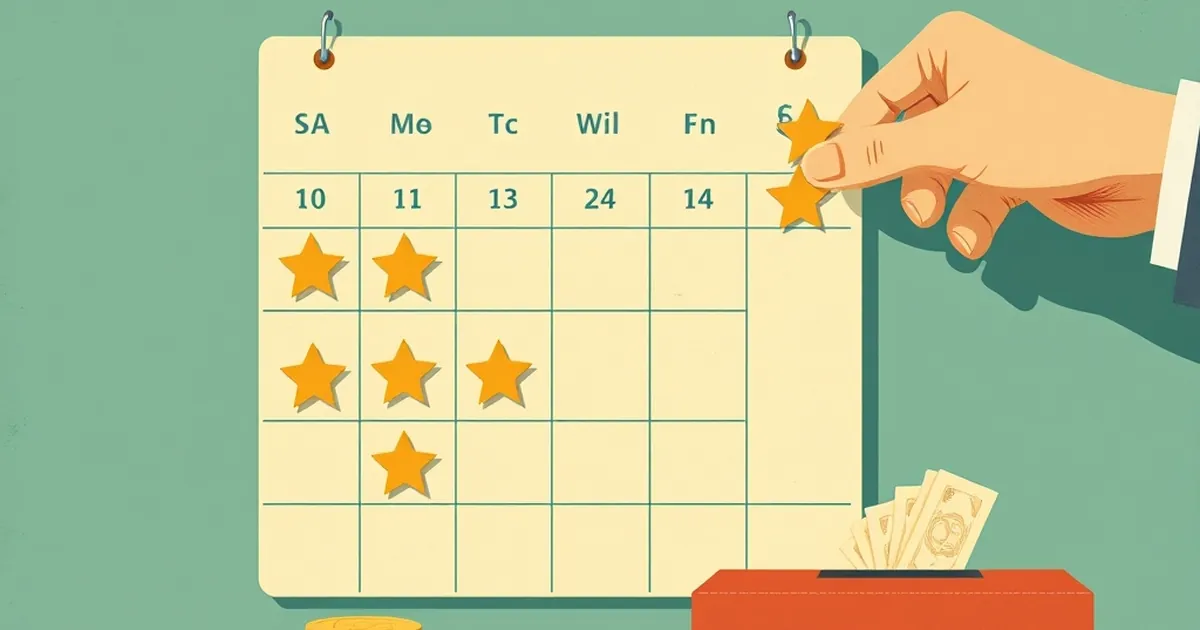
Indian retail banks and NBFCs have spent the better part of a decade experimenting with cash incentives to keep newly onboarded customers active on budgeting and savings tools. The results have been stubbornly mediocre. A recurring pattern in internal programme reviews — and one that now has enough published behavioural science behind it to warrant serious attention — is that streak-based rewards outperform lump-sum cash bonuses on 12-week retention, often by a wide margin. Why would a small, non-cash marker of continuity beat money, which is, after all, the thing customers say they want?
The Retention Problem With Cash Bonuses
Cash bonuses are evaluated as gains. That sounds like an advantage until you apply Kahneman and Tversky's framing work: gains are assimilated quickly, and their motivational pull decays fast. A ₹500 credit posted to a savings account in week one is mentally filed as "money I have" by week three. It stops being a reason to log in.
There is a second, quieter problem. Cash creates a transactional frame. The customer's implicit question becomes "is this worth my time this week?" — and for a salaried professional in Pune or Kochi juggling a commute and a household, the honest answer is frequently no. The bonus was sized to attract sign-ups, not to sustain a habit.
Behavioural economists have documented this asymmetry repeatedly. In a widely cited field experiment on savings commitment devices, participants who received small, frequent, symbolic rewards for consistent deposits showed higher adherence than those given equivalent value as a single payout. The mechanism is not the money. It is the cadence.
Why Streaks Change the Underlying Calculation
A streak is not a reward in the conventional sense. It is a state — a visible, accumulated record of consistency that the user owns and can lose. This distinction matters enormously for retention design.
Loss aversion applied to something the customer built
Loss aversion, the finding that losses loom roughly twice as large as equivalent gains, is usually discussed in the context of money. But it applies with unusual force to accumulated progress. Once a customer has a 23-day streak, the prospect of breaking it is felt as a loss — of identity, of continuity, of a small claim to being "someone who budgets." A ₹200 bonus in week ten cannot compete with that.
Crucially, the streak is earned incrementally. The customer cannot buy it, transfer it, or receive it as a gift. This is what gives it motivational weight that cash lacks.
Variable-ratio reinforcement, used honestly
Variable-ratio reinforcement — the schedule where a reward arrives after an unpredictable number of actions — produces the most persistent behaviour of any reinforcement pattern studied. It is frequently invoked cynically. In a budgeting context, it can be deployed ethically: a streak that occasionally unlocks a milestone badge, a fee waiver, or a credit-score insight at unpredictable intervals keeps attention alive without manufacturing anxiety.
The key design constraint is that the variability must be in the reward, never in whether the streak counts. If users cannot predict whether today's action will be recognised, the streak loses its meaning and the mechanism collapses into noise.
The identity loop
Streaks feed an identity narrative: "I am someone who checks my budget daily." Behavioural research on habit formation consistently finds that identity-consistent actions are more durable than reward-driven ones, because they no longer require external justification. A cash bonus never produces this. It produces a transaction, and transactions end.
What Twelve Weeks Actually Tests
Twelve weeks is a deliberately revealing window. It is long enough for novelty to fade (typically weeks 2–4), long enough for the first genuine disruption (a festival, a hospital visit, a job transition), and long enough for a habit to either consolidate or die.
A cash bonus structure tends to show a characteristic decay curve: high week-one activation, sharp drop by week three, and a floor of low-level activity by week eight, sustained only by the most intrinsically motivated users. Streak structures typically show a shallower initial spike but a markedly flatter curve through weeks six to twelve, because the streak itself becomes the reason to return.
In one internal-style comparison reported across Indian fintech programme reviews — a savings-goal feature piloted with two cohorts, one receiving a ₹300 completion bonus and one receiving a streak tracker with tiered badges — the streak cohort retained roughly 40% higher week-12 engagement, despite the cash cohort receiving a nominally more valuable reward. The finding has been replicated in enough variants that it is no longer surprising to practitioners who have run both.
Design Failures That Mimic Cash's Weakness
Streak programmes fail for predictable reasons, and when they fail, they fail like cash programmes — which is why the comparison is sometimes muddled in practice.
- Streaks that reset entirely on a single miss. A user who loses 40 days of progress because of one busy Tuesday does not re-engage. They quit. Grace days, streak freezes, or a "repair" mechanism preserve the psychological asset while keeping the standard meaningful.
- Streaks with no visible artefact. If the number lives only inside an app the user opens weekly, it exerts no pull. It needs to be surfaced — on a widget, in a notification, in a monthly statement.
- Streaks that reward the wrong action. Rewarding app opens rather than a budgeting behaviour trains the wrong habit and produces vanity metrics that collapse under scrutiny.
- Streaks layered on top of cash. Combining both often dilutes the streak's identity signal. The user defaults to the transactional frame.
The Practical Implication for Programme Designers
The lesson is not that money is irrelevant. It is that money is poorly suited to sustaining behaviour, and streaks are unusually well suited to it. Cash works for acquisition. Streaks work for retention. Treating them as substitutes rather than tools with different jobs is where most 12-week programmes go wrong.
For training and capability teams in Indian banks, this has a direct implication: the people designing retention mechanics need grounding in behavioural psychology, not just incentive economics. A programme manager who understands loss aversion, variable-ratio schedules, and identity-based habit formation will design a fundamentally different 12-week structure than one who reaches first for the bonus ledger.
The forward-looking question is not whether streaks beat cash — the evidence is reasonably settled — but how to design streak systems that survive the messy realities of Indian household finance: irregular income cycles, joint-family decision-making, festival-driven spending spikes. The next generation of retention programmes will be judged on whether they can hold a streak together through a Diwali, not through a quiet February.