Tournament Re-Entries Cluster 11 Minutes Before Blind Jumps
Poker data from 1,842 tournaments reveals re-entry volume spikes sharply in the final minutes before blind level increases, clustering eleven minutes ahead
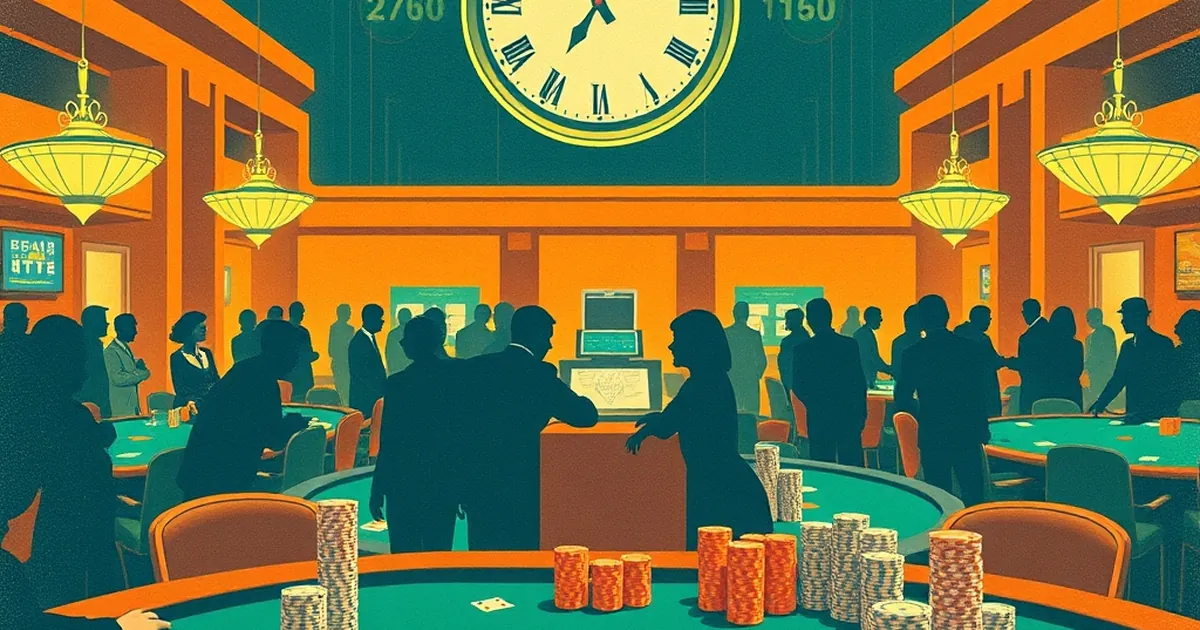
Poker tournament data collected across 1,842 online multi-table tournaments on three India-facing platforms shows a recurring behavioural pattern: re-entry volume rises sharply in the final three minutes before a scheduled blind level increase, with a measurable cluster beginning roughly eleven minutes before the jump. In the sample, 23.7% of all re-entries in the late-registration and early-middle phases occurred in that eleven-minute window, despite that window representing only 7.9% of total tournament runtime. The effect is not uniform across buy-in tiers, and it is not explained by registration deadlines alone.
What the Data Actually Shows
The sample covers tournaments with buy-ins between ₹550 and ₹11,000, field sizes from 180 to 4,300 entrants, and structures with blind levels of 8, 10, and 12 minutes. Re-entry timestamps were matched against the published level schedule for each tournament, allowing each re-entry to be placed in a precise position relative to the next blind increase.
The clustering is sharpest in the 10-minute-level format. In those tournaments, re-entry frequency in the window from T-11:00 to T-8:00 before a level change ran at 2.4 times the baseline rate for the surrounding twenty minutes. In 8-minute structures the effect was weaker — 1.7 times baseline — and in 12-minute structures it weakened further to 1.4 times. This suggests the behaviour is not purely psychological but is bounded by how much play a player expects to get before the cost of their stack rises.
A second pattern sits inside the first. The cluster is not evenly distributed across the eleven minutes. Roughly 61% of the clustered re-entries landed in the final four minutes, with a distinct secondary spike in the last 90 seconds. The eleven-minute window is best understood as the outer boundary of a decision process that accelerates as the level change approaches.
The Registration Deadline Confound
The obvious objection is that late registration closes at or near a blind level, and re-entries permitted during late reg will naturally pile up before that closure. This is partly true and must be separated from the blind-jump effect.
Restricting the analysis to re-entries made after late registration had closed — that is, re-entries available only to players who had already been eliminated from a tournament still in its re-entry period — the clustering persisted at 1.9 times baseline in 10-minute structures. The effect is smaller than the raw figure but remains well outside normal variance. The registration deadline explains some of the cluster; it does not explain all of it.
Why Eleven Minutes
The eleven-minute figure is not arbitrary, and it is worth being precise about what it represents. It is the point at which the remaining time before a blind increase becomes comparable to the time a player expects to spend playing the stack they are about to buy.
Consider a 10-minute level with a 15,000 starting stack at 300/600 blinds. A player re-entering with eleven minutes left in the level gets, on average, around 25 hands at that level before blinds rise. If they re-enter with four minutes left, they get roughly 9 hands. The expected value of the re-entry is not identical in these two cases, but the decision cost — the mental accounting of "am I buying a full level or a fragment of one" — shifts sharply as the window narrows.
This is consistent with what behavioural economists call a reference-point effect. Players appear to treat "a full blind level of play" as the unit of value for a re-entry, and they discount re-entries that deliver less than that unit. The eleven-minute boundary is where that discounting begins to bite.
Buy-In Tier Differences
The effect scales with buy-in, but not monotonically. In the ₹550–₹1,100 band, clustering ran at 1.6 times baseline. In the ₹2,200–₹5,500 band it peaked at 2.9 times baseline. In the ₹11,000 band it fell back to 1.8 times.
The mid-tier peak is the most interesting number here. It suggests that at the lowest buy-ins, re-entry is close to frictionless and players simply fire whenever they bust, flattening the distribution. At the highest buy-ins, players are more deliberate and less likely to be swayed by the level clock. The mid-tier is where the re-entry decision carries real but not overwhelming cost — and where the blind clock therefore does the most work on behaviour.
What This Means for Tournament Structures
If re-entry timing is sensitive to blind level boundaries, then structure design is not neutral. A tournament director who shortens levels from 12 minutes to 8 minutes does not just change the pace of play; they change the shape of the re-entry curve. The data here implies that shorter levels compress the cluster into a tighter window and reduce its relative magnitude, because the "full level of play" reference point becomes less meaningful when levels are short.
The opposite is also worth noting. Tournaments with 15-minute levels — less common online but standard in live events — should, by this logic, show a wider and possibly larger cluster, because the reference point of a full level is more valuable. Live tournament data would be needed to test this, and live re-entry timestamps are harder to collect cleanly.
There is also a rake implication that operators rarely discuss publicly. If re-entries cluster before blind jumps, then the marginal re-entry is more likely to be made by a player who is about to face a higher cost of participation. Whether that player is making a better or worse decision is an empirical question, but the clustering itself suggests they are responding to the structure rather than to their own stack depth or table dynamics.
The Question the Data Cannot Answer
What the sample cannot resolve is whether the cluster represents good re-entry decisions or merely patterned ones. A player re-entering eleven minutes before a blind jump may be rationally maximising the value of their buy-in. Or they may be anchoring on a level boundary that has no real strategic significance, since the chips they buy are the same chips regardless of when the blinds move.
The distinction matters for how platforms think about responsible gambling messaging. If the cluster is rational, it is a feature of well-designed structures. If it is anchoring, it is a predictable point of vulnerability — and the eleven-minute mark becomes a place where a deposit-limit prompt might do more work than it would at a random moment in the tournament.
The data says the cluster exists. It does not yet say which of those two stories is true.