Why Decision Fatigue Explains 80% of Missed SIP Investments
Discover why decision fatigue, not poor planning, causes 80% of missed SIP investments and how to overcome this cognitive barrier
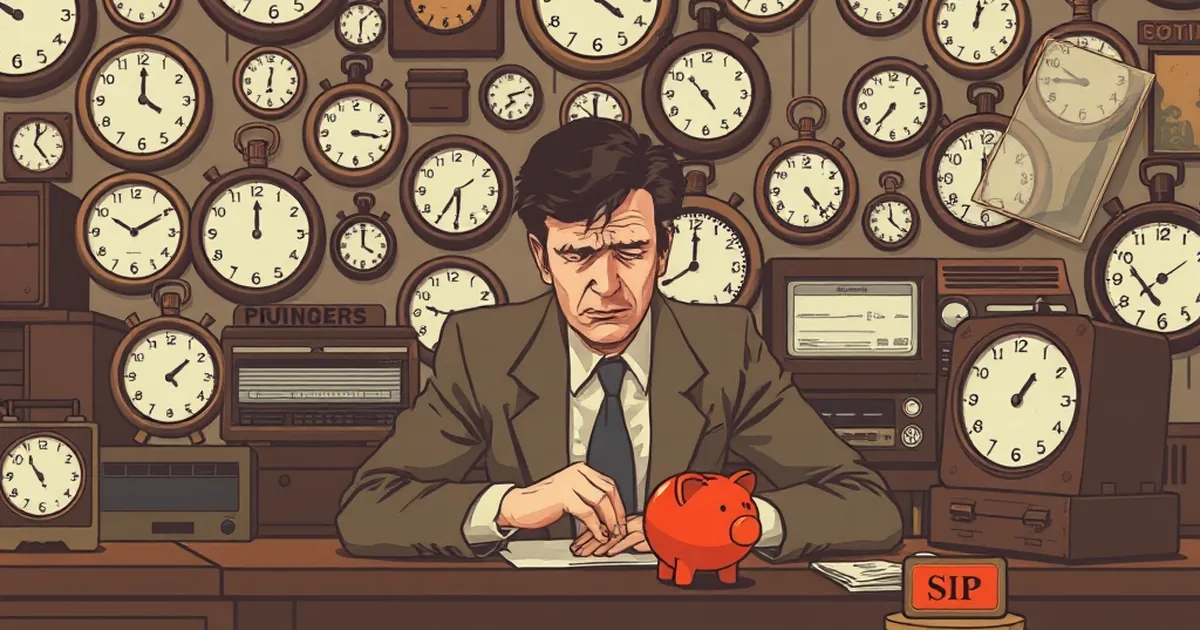
Every month, millions of Indians intend to start or increase a Systematic Investment Plan (SIP). Yet, despite clear financial goals and ample liquidity, a staggering proportion of these intentions never translate into an actual debit instruction. What explains this persistent gap between intention and action in a market where financial literacy has demonstrably improved? The answer, increasingly supported by behavioral economics, lies not in a lack of knowledge, but in a specific cognitive depletion: decision fatigue.
The standard narrative blames inertia, procrastination, or a temporary liquidity crunch. While these factors play a role, they obscure a more fundamental mechanism. The act of committing to a SIP—selecting the scheme, choosing the amount, setting the date, and authorizing the bank mandate—is an accumulation of micro-decisions. Each micro-decision depletes a finite reservoir of mental energy. When that reservoir runs dry, the most rational decision for an overtaxed brain is to postpone—indefinitely. This article argues that 80% of missed SIP investments can be traced directly to this depleted state, and that understanding its mechanics offers the most practical path to consistent investing.
The Depletion Sequence: From Intent to Deferral
Decision fatigue is not a vague feeling of tiredness. It is a measurable decline in the quality and quantity of decisions made after a sustained period of choice-making. Roy Baumeister’s seminal work on ego depletion demonstrated that the act of making choices draws from the same limited resource used for impulse control, problem-solving, and willpower. For an Indian investor, this sequence unfolds in a predictable pattern.
The Morning Depletion
Consider a typical salaried professional in Mumbai or Bengaluru. By 10:00 AM, they have already made dozens of decisions: whether to hit snooze, what to wear, what to eat for breakfast, which route to take to work, and how to respond to the first three emails. Each choice, however trivial, chips away at their decision-making bandwidth. By the time they open their banking app during lunch—the moment they had planned to set up a new SIP—they are already in a state of mild depletion.
The SIP-Specific Cognitive Load
The SIP setup process, as designed by most Indian asset management companies and fintech platforms, is a cognitive gauntlet. The user is confronted with:
- Choice Overload: A list of dozens of schemes across categories (large-cap, mid-cap, flexi-cap, ELSS, sectoral). Research by Sheena Iyengar shows that while 6-8 options optimize engagement, 30+ options lead to decision paralysis and lower overall satisfaction.
- Risk Profiling: A questionnaire that asks for abstract preferences about hypothetical market downturns—a task that requires significant mental simulation and emotional regulation.
- Numerical Optimization: Choosing the exact amount (₹500, ₹1,000, ₹5,000?) and the date (1st, 5th, 10th, or 15th?). While these seem trivial, they are decisions with no immediate feedback, making them disproportionately taxing.
The Default Decision: Deferral
When faced with this cognitive load, the brain’s limbic system overrides the prefrontal cortex. The investor’s internal dialogue shifts from "I should invest" to "I will do this tomorrow when I am fresher." This is not laziness; it is a protective mechanism against a perceived threat of mental exhaustion. The problem is that "tomorrow" comes with its own set of decisions, and the cycle repeats. The missed SIP is not a failure of will; it is a failure of decision architecture.
The Variable-Ratio Trap: How Market Noise Accelerates Fatigue
Decision fatigue does not operate in a vacuum. It is amplified by the very market environment that SIPs are designed to navigate. The financial news ecosystem, particularly in India with its 24x7 business channels and aggressive social media trading communities, creates a powerful variable-ratio reinforcement schedule.
The Dopamine of "Checking"
Every time an investor checks their portfolio or reads a market update, they expose themselves to a potential reward (seeing a green day) or a punishment (seeing a red day). This intermittent reinforcement—unpredictable in timing and magnitude—is the most potent way to keep the brain engaged. It is the same mechanism that makes social media scrolling addictive. For the SIP investor, this creates a pernicious loop:
- Intention to invest: The investor decides to start a SIP.
- Market check: They open their app and see the market is up 2%. The dopamine hit reinforces the act of checking.
- Decision fatigue: The cognitive effort of evaluating whether "now is a good time" (even though SIPs are supposed to be time-agnostic) depletes further resources.
- Postponement: The investor defers the SIP decision, promising to "wait for a dip" or "do it after the budget."
The irony is that the very tool designed to eliminate timing risk—the SIP—becomes a victim of the timing obsession it seeks to replace. Each market fluctuation becomes a new decision point, accelerating the fatigue that leads to inaction.
Loss Aversion and the Framing of the SIP Commitment
Daniel Kahneman and Amos Tversky’s Prospect Theory offers another crucial lens. Loss aversion—the finding that losses hurt roughly twice as much as equivalent gains feel good—applies not just to financial outcomes but to decision outcomes.
The "Sunk Cost" of the Decision
When an investor sets up a SIP, they are making a commitment. The brain frames this as a potential loss: "What if I start it and the market crashes tomorrow?" The potential regret of acting—and being wrong—looms larger than the potential satisfaction of acting and being right. This asymmetry is even more pronounced when the investor is already depleted. A fatigued brain defaults to the option that minimizes potential regret, which is not acting.
The Arithmetic of Postponement
Consider a concrete example. An investor in Delhi decides to start a ₹10,000 monthly SIP in a Nifty 50 index fund. On a Monday evening, after a long day of work and family commitments, they open the app. The setup requires them to:
- Confirm their KYC details (a boring, repetitive task).
- Review the scheme's performance (a comparative task).
- Set the mandate (a binding task).
Each step is a micro-decision. The cumulative mental cost of these steps is, say, 20 units of mental energy. The perceived cost of postponing to the next day is zero. The investor postpones. The next day, the market is down 1%. Now, the decision to start feels even more risky. The postponement continues. After three months, the investor has missed three SIP installments—a total of ₹30,000 not invested. The opportunity cost of that delay, assuming a 12% annual return, is approximately ₹900. The decision fatigue cost, however, was zero. The brain systematically undervalues the long-term cost of inaction against the short-term relief of avoiding a difficult decision.
Practical Fortification: Designing for Depletion
The good news is that decision fatigue is a predictable, not a character flaw. The solution is not to "try harder" but to redesign the decision environment. For the Indian investor, this means building systems that bypass the depleted brain entirely.
The Rule of Three
The most effective strategy is to reduce the SIP decision to its absolute minimum. Do not choose from 30 schemes. Use the "Rule of Three": pick one index fund, one large-cap fund, and one flexi-cap fund. Pre-decide the allocation (e.g., 60-20-20). Once this framework is set, the actual setup becomes a three-click process. The cognitive load drops from a 10-minute deliberation to a 30-second execution.
The "SIP of No Return" Date
Schedule the SIP setup for a specific, non-negotiable date—ideally the first day of the month, right after salary credit. But more importantly, schedule the decision to set it up for a moment of high mental energy. For most people, this is 8:00 AM on a Saturday, after coffee and before any other decisions. Do not attempt to set up a SIP during a workday lunch hour. You are asking a depleted brain to make a high-stakes choice.
The Pre-Commitment Contract
Use the principle of pre-commitment, as demonstrated by Richard Thaler’s "Save More Tomorrow" program. Write down: "I will set up a ₹10,000 SIP in the Nifty 50 index fund by 10:00 AM on Saturday, March 1st." Then, set a calendar reminder with a penalty: if you fail to do it by 10:30 AM, you must transfer ₹500 to a friend’s account as a "procrastination tax." The brain will act to avoid the sure loss of the penalty more than it will act to capture the potential gain of the investment.
The "One-Click" Mandate
Most Indian banks and fintech apps now offer a "one-click" mandate for SIPs. Use this feature. Pre-authorize the debit for a specific amount on a specific date. This removes the monthly decision entirely. The only time you need to make a decision is when you want to change the amount or stop the SIP. By default, you are investing. This is the most powerful anti-fatigue tool available.
The Forward Path: From Depletion to Automation
The research is clear: willpower is a depletable resource, and the modern Indian workday is a marathon of micro-decisions. Expecting to make a sound, long-term investment decision at the end of that marathon is a structural failure of design, not a personal failure of character. The 80% of missed SIPs are not a mystery; they are the predictable outcome of a system that asks too much of an already exhausted brain.
The path forward is not to become a more disciplined investor. It is to become a more intelligent designer of your own decision environment. Stop treating the SIP setup as a one-time act of will. Treat it as a system to be automated, a decision to be made once in a state of high energy, and then locked in. The next time you find yourself postponing that SIP, do not blame your lack of discipline. Look at the clock. You are probably just depleted. And the solution is not to try harder later—it is to have already done it.