Why Indian Bank Exams Test Securitisation Transaction Structures
Understand why Indian bank exams test securitisation transaction structures, from SPV roles to true sale distinctions, to assess deeper conceptual clarity
If you have spent any time preparing for Indian banking exams—whether for IBPS, SBI, or RBI Grade B—you have likely encountered a question on securitisation. It is not a niche topic reserved for the elective paper; it appears in the conceptual clarity section of Phase II and sometimes in the General Awareness segment. The question is rarely a simple definition. Instead, it asks you to trace the flow of assets, identify the Special Purpose Vehicle (SPV), or distinguish between a true sale and a collateralised loan. This is not accidental. The exam board is testing something deeper than your memory. They are testing your ability to understand how risk is repackaged, priced, and transferred in a system where banks are increasingly required to manage capital efficiently.
Why Securitisation Matters More to Indian Banks Than Ever
The Indian banking sector has undergone a structural shift since the Asset Quality Review (AQR) of 2015. Non-Performing Assets (NPAs) peaked, provisioning ate into profits, and the regulatory gaze from the Reserve Bank of India (RBI) intensified. In this environment, securitisation emerged as a legitimate tool for credit risk transfer, not just a Wall Street invention. Banks needed ways to free up capital tied in standard loans to make room for fresh credit. Securitisation allowed them to do precisely that.
However, this tool comes with a catch. If the transaction is structured poorly—if the originating bank retains too much risk or if the SPV is not bankruptcy-remote—the entire exercise becomes a façade. The regulator understands this. Therefore, exam questions on securitisation are not academic whims. They are a proxy for assessing whether a future banker understands the line between genuine risk transfer and regulatory arbitrage. When you answer a question on securitisation correctly, you signal that you comprehend the capital adequacy framework beyond the textbook formula.
The RBI's Direct Influence on Exam Content
The RBI has issued detailed master directions on securitisation, most notably the Securitisation of Standard Assets directions. These guidelines specify minimum holding periods, minimum retention requirements (typically 5% to 10% of the securitised pool), and the conditions for a true sale. An examiner drafting a question for the JAIIB or CAIIB paper, or for a probationary officer exam, draws directly from these regulatory documents. They want to know if you can apply the rule, not just recite it.
For example, a typical question might present a scenario where a bank sells a pool of auto loans to an SPV but continues to service the loans. The question will ask: does this constitute a true sale under the RBI guidelines? The answer hinges on whether the bank has transferred the significant risks and rewards of ownership. If the bank has provided a credit enhancement that covers the first 10% of losses, the answer is no. This is not trivia. This is the kind of judgment a credit officer needs on the job.
The Anatomy of a Securitisation Transaction Structure in Indian Exams
To understand why exam boards test this, you must first understand the structure itself. A standard securitisation transaction in the Indian context involves three core participants: the originator (the bank or NBFC that holds the loans), the SPV (a trust that acquires the pool of assets), and the investors (typically mutual funds, insurance companies, or other banks). The cash flows from the underlying loans—home loans, car loans, or microfinance receivables—are passed through to the investors.
The exam will test your grasp of this flow. The most common error candidates make is confusing securitisation with a simple sale of loans. In a sale, the buyer takes over the loan account directly. In securitisation, the loans are pooled, and securities backed by those loans are issued. The borrower on the ground may not even know their loan has been securitised. This distinction is critical because it affects how the asset is treated on the originator's balance sheet.
The Role of Credit Enhancement and Tranches
A second layer of complexity involves credit enhancement. Indian exams frequently ask about the different tranches: senior, mezzanine, and equity (or first-loss). The equity tranche absorbs the first losses from the pool. Who holds this tranche matters. If the originator holds the equity tranche, the regulator may not consider the assets as truly sold off the balance sheet. The exam tests this because the RBI's guidelines explicitly state that the originator cannot retain risks that exceed the specified thresholds.
Consider a concrete example from a recent SBI PO mains paper. A question described a securitisation of tractor loans where the originating NBFC provided a cash collateral of 8% of the pool value. The question asked whether this cash collateral constituted a credit enhancement and whether it violated the minimum retention requirement. The correct answer required you to know that the RBI allows retention in the form of an equity tranche or a seller's share, but that the structure must be disclosed. This is a direct test of your ability to read a transaction document, not just a textbook.
Why This Knowledge Separates a Clerk from an Officer
The distinction between a clerical role and an officer role in Indian banking often comes down to judgment. A clerk executes transactions. An officer structures them or, at the very least, evaluates their risk. Securitisation is a classic example of a structured product that demands judgment. If you are posted in the treasury or the credit risk department, you will encounter securitisation deals, either as an originator or as an investor.
The exam is therefore a screening mechanism. It forces you to think about the legal versus economic substance of a transaction. A bank may legally sell a pool of loans to an SPV, but if it provides a guarantee or a liquidity facility that covers most of the default risk, the economic substance is that the bank still carries the risk. The RBI's true sale criteria are designed to catch this gap. If you can answer a question on this, you have demonstrated that you understand the difference between form and substance—a skill that is invaluable in a regulatory-driven environment.
The Anecdote of the IL&FS Fallout
The IL&FS crisis of 2018 provides a stark lesson. IL&FS Financial Services had originated a large volume of loans and securitised them. When the crisis hit, it was discovered that many of these transactions had not achieved a true sale. The SPVs were not fully bankruptcy-remote, and the originator was still exposed. The ripple effect froze the Indian credit market for months. Regulators responded by tightening the securitisation framework further. Every banker who went through that period now understands why the structure matters. The exam questions are a reflection of this lived experience. They are not abstract.
A Practical Takeaway for Your Exam Preparation
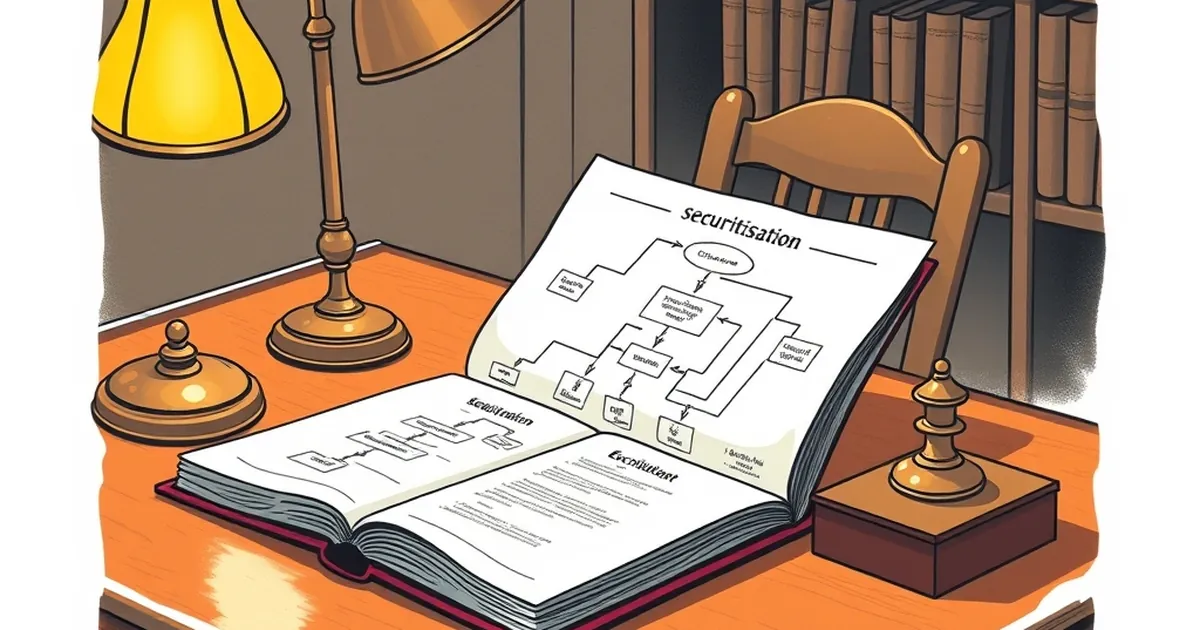
Stop memorising the definition of securitisation from a single source. Instead, learn to draw the transaction structure on a sheet of paper. Label the originator, the SPV, the investors, and the servicer. Draw arrows for cash flows and for risk transfers. Then, overlay the RBI's requirements: where is the minimum retention? Where is the credit enhancement? Where is the true sale condition met or broken? If you can redraw that diagram from memory, you will answer any securitisation question correctly.
The forward-looking note is this: as India moves towards a more market-based credit system, where banks originate loans to distribute them rather than hold them to maturity, securitisation will only grow in importance. The next generation of bankers will need to structure and evaluate these transactions routinely. The exam is not testing your past knowledge; it is testing your readiness for that future. Treat every securitisation question as a practice run for a real-world deal. That shift in mindset will serve you far beyond the exam hall.