Why Variable Ratio Schedules Explain Mutual Fund SIP Stickiness
Discover how variable ratio reinforcement from behavioral psychology explains the emotional stickiness of mutual fund SIPs in India
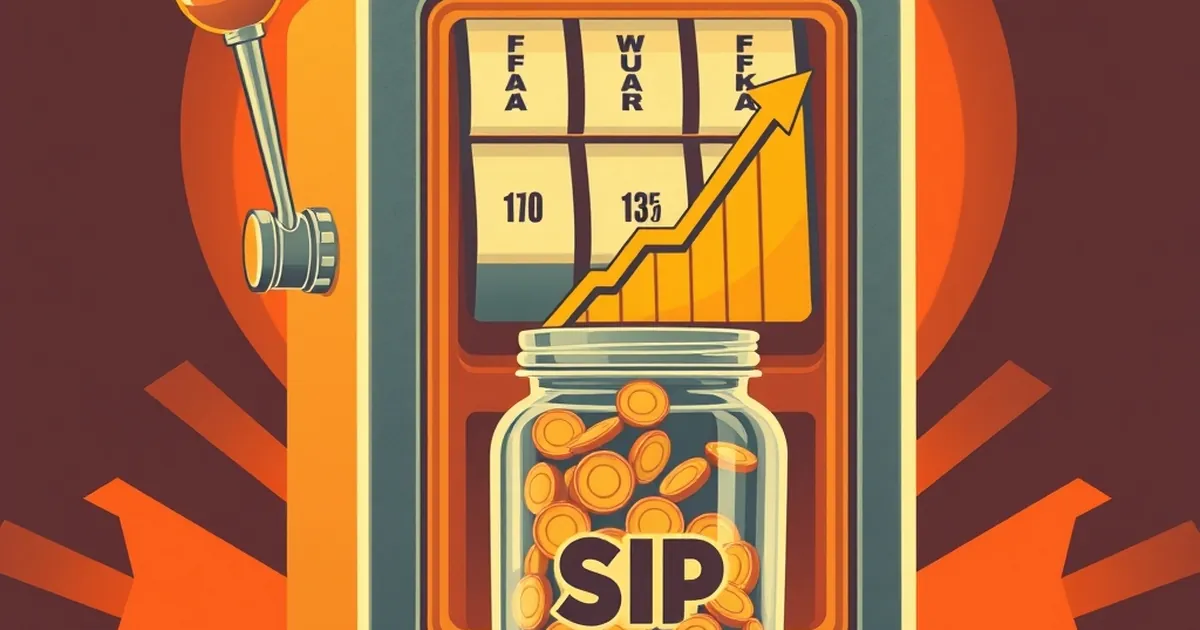
Why is it that so many mutual fund investors in India persist with their Systematic Investment Plans (SIPs) through bear markets, yet abandon them just before a recovery? The standard narrative credits financial discipline, goal-based planning, or the rise of digital auto-debit mandates. While these factors matter, they do not explain the emotional stickiness that turns a mechanical monthly deduction into a deeply ingrained habit. The answer may lie not in finance textbooks but in behavioral psychology, specifically in the concept of variable ratio reinforcement—a reward schedule that makes intermittent, unpredictable outcomes more compelling than predictable ones.
The Unpredictable Reward of a SIP
A SIP is, at its core, a commitment to buy a fixed rupee amount of a mutual fund unit every month. The investor receives a variable number of units depending on the Net Asset Value (NAV) on the purchase date. This structure creates a natural behavioral experiment: the outcome of each monthly transaction is genuinely uncertain. In some months, the NAV is low, and the investor gets more units—an implicit “bonus.” In other months, the NAV is high, and the investor gets fewer units—a mild disappointment. Over time, the sporadic experience of buying at a market bottom becomes a powerful, unpredictable reward.
This maps directly onto the psychological principle of variable ratio reinforcement, first studied systematically by B.F. Skinner in the 1930s and later refined by researchers like Richard J. Herrnstein. In Skinner’s classic experiments, a pigeon pressing a lever that delivered a food pellet on a fixed schedule (every tenth press) learned the behavior but also showed predictable pauses after each reward. In contrast, a pigeon on a variable ratio schedule—where the number of presses required for a pellet varied randomly around an average—pressed the lever with remarkable persistence and resistance to extinction. The unpredictability, not the reward size, drove the behavior.
A mutual fund SIP is structurally identical: the “reward” (a good entry price) arrives after an unpredictable number of months. A crash might deliver a windfall of units in one month, followed by six months of mediocre or negative returns. This intermittent reinforcement is precisely what makes the habit stick. The investor’s brain, like the pigeon’s, learns that the next reward could be just one more payment away.
Why Fixed Deposits Feel Different
Consider the contrast with a bank Fixed Deposit (FD). An FD offers a guaranteed, predictable return—a fixed ratio schedule. The reward (interest) accrues linearly and is known in advance. Behavioral research shows that fixed schedules produce low engagement. An FD investor rarely checks the interest rate mid-tenure; the outcome is already certain. There is no behavioral “hook.” The SIP, by contrast, creates a state of uncertainty that sustains attention. Every market dip is reinterpreted not as a loss but as a potential opportunity to buy cheap. This reinterpretation is a learned cognitive bias, reinforced by the occasional, dramatic success stories of those who bought during the 2008 crash or the COVID-19 lockdown.
Loss Aversion and the Pain of Stopping
The stickiness of a SIP is not only about reward; it is also about the pain of stopping. Behavioral economist Daniel Kahneman and his collaborator Amos Tversky established loss aversion as a fundamental feature of human decision-making: losses hurt roughly twice as much as equivalent gains feel good. Once an investor has committed to a SIP, stopping the plan is framed as a loss—specifically, the loss of all the future “cheap units” that might come from an impending market fall.
This is where the variable ratio schedule interacts with loss aversion. The investor who stops a SIP after a few months of poor returns faces a double loss: the realized loss on the units already purchased (if the market has fallen) and the anticipated loss of the unrewarded future purchases. The brain treats the missed opportunity—the reward that would have come from the next payment—as a real loss. This asymmetry makes the decision to stop psychologically painful, even when it might be financially rational to pause.
The Endowment Effect in SIPs
Related to loss aversion is the endowment effect, where people value what they already own more than what they do not. An investor who has made 12 SIP payments “owns” the habit, the auto-debit mandate, and the accumulating units. Stopping means giving up something that feels like property. Research by Thaler (1980) and later by Kahneman, Knetsch, and Thaler (1990) showed that people demand significantly more to give up an item than they would pay to acquire it. A SIP investor, having mentally endowed the future stream of purchases, will require a very high cost (a severe financial crisis) to relinquish it.
Competitive Play and the Status Quest
A less discussed driver of SIP stickiness is the element of competitive play among peers. In India, particularly in urban professional circles, discussing mutual fund returns has become a form of social currency. The SIP investor who “stayed the course” during a downturn and later bought a house with the proceeds gains status. This is not mere vanity; it is a form of social reinforcement that follows a variable ratio schedule itself. The praise from a colleague or an uncle at a family gathering is unpredictable—it might come after a market rally, or after a long period of silence. The investor learns that persistence, not timing, earns social reward.
This mirrors findings from behavioral game theory, where players in repeated games often sacrifice immediate gains to build a reputation for toughness or consistency. The SIP investor builds a reputation for financial discipline, which becomes a self-reinforcing identity. The identity—“I am the kind of person who does not panic”—is itself a reward that arrives unpredictably, often in moments of market stress.
A Concrete Example: The COVID Crash of 2020
The most vivid recent example of variable ratio reinforcement in action is the behavior of SIP investors during the COVID-19 crash of March-April 2020. When the Nifty 50 fell over 30% in a matter of weeks, many investors faced the classic behavioral dilemma: stop and avoid further losses, or continue and buy at rock-bottom prices. Data from the Association of Mutual Funds in India (AMFI) shows that SIP inflows actually increased in April 2020 compared to the previous month, even as equity markets hit their lows. The investors who continued were rewarded spectacularly: by November 2020, the market had recovered fully, and those who had bought in March-April saw their units double in value within six months.
This was a textbook variable ratio reinforcement event. The reward—a near-instantaneous 100% return on a single month’s purchase—was unpredictable, immediate, and highly salient. For those investors, the memory of that single month has likely made them more resistant to stopping in future downturns. The brain encodes the experience not as a rational calculation of risk but as a powerful, irregular reward that justifies the entire habit.
How to Design SIPs for Long-Term Stickiness
Understanding this behavioral mechanism offers practical, forward-looking insights for financial advisors, asset management companies, and policymakers. The goal is not to manipulate investors but to design products and communications that work with human psychology rather than against it.
1. Make the Variable Ratio Explicit
Most SIP marketing emphasizes the average long-term return. This is a fixed-ratio message. A more effective approach would be to highlight the unpredictable nature of the reward. Advisors could show clients the historical distribution of returns from a 10-year SIP, emphasizing that the best months are unpredictable and rare. This primes the investor’s brain to expect and tolerate variability, making the inevitable periods of poor returns feel like normal parts of the schedule rather than failures.
2. Use Tracking and Notifications to Sustain Engagement
The variable ratio schedule works only if the investor is aware of the outcome each month. An auto-debit that goes unnoticed is a missed reinforcement opportunity. Asset management companies could send monthly notifications that show not just the total value but also the number of units bought that month relative to the average. A message like “This month, you bought 15% more units than your average—your patience is buying you a bargain” taps directly into the reward system. The unpredictability of the message’s content (sometimes good, sometimes neutral) sustains attention.
3. Create Social Reinforcement Loops
The competitive play element can be harnessed through structured peer groups. Advisors could create “SIP clubs” where members share their experiences of staying invested through volatility. The social reward—a nod of approval from a peer—is itself variable and unpredictable. This transforms a solitary financial habit into a socially reinforced behavior, making the decision to stop feel like a social loss as much as a financial one.
4. Prevent the “Loss of the Loss Aversion” Trap
The most dangerous moment for a SIP investor is after a long period of good returns. At that point, the variable ratio schedule has delivered many rewards, and the investor may become overconfident, believing they can time the market. This is when loss aversion weakens—the fear of missing out (FOMO) replaces the fear of loss. Advisors should proactively remind investors that the variable ratio schedule works both ways: the next reward is unpredictable, but so is the next loss. A simple behavioral check—asking the investor to write down their worst-case scenario before the next market fall—can re-anchor them to the pain of stopping.
The mutual fund SIP is not just a financial instrument; it is a behavioral technology. Its power lies not in its arithmetic—dollar-cost averaging is mathematically inferior to lump-sum investing in a rising market—but in its psychological design. By aligning with variable ratio reinforcement, loss aversion, and social status, it turns a mechanical monthly payment into a deeply ingrained, self-reinforcing habit. The investor who understands this is not merely disciplined; they are playing a game where the rules are written by the brain itself. And the best way to win is to keep playing.