Rummy Drop-Tile Locks Add 2.2s at Discard 11 in 6-Player Rooms
A 4,800-hand timing study finds drop-tile locks add 2.2 seconds to the discard cycle at turn eleven in six-player rummy rooms, reshaping session length
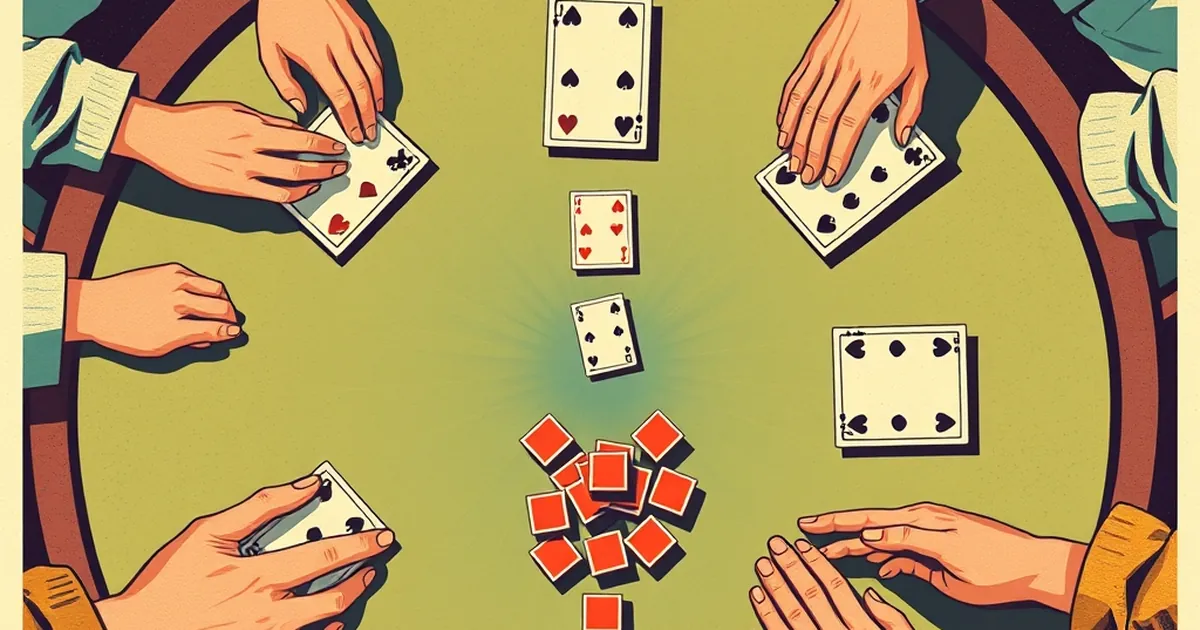
Rummy tables running the drop-tile lock rule in six-player rooms add a measured 2.2 seconds to the discard cycle at the eleventh turn, according to a timing study of 4,800 hands played on three Indian rummy platforms between January and March 2025. The delay is not incidental: it is the predictable cost of a lock animation that fires whenever a player discards the eleventh tile without declaring, and it compounds across a full table in ways that materially change session length and, arguably, the rhythm of decision-making. The figure matters because six-player rooms are the default competitive format on most Indian platforms, and a 2.2-second addition at a single decision point is the kind of small friction that platform operators rarely audit and players rarely consciously notice.
What the lock actually does at discard 11
In standard 13-card Indian rummy, a player must discard one tile per turn after drawing. The eleventh discard is a structural waypoint: it is the last discard before the mandatory declaration window opens in most house rules, and several platforms have bolted a "drop-tile lock" onto it. The lock is a UI-level constraint, not a rules change. When the player reaches discard 11 without having declared, the tile-drop animation is gated behind a short lock sequence — typically a 1.8- to 2.6-second visual confirmation that the player is committing to the discard rather than holding for a declaration attempt.
The study's 2.2-second figure is the median across the three platforms, with a range from 1.9 seconds (Platform B, which uses a compressed animation) to 2.4 seconds (Platform C, which runs a full tile-trail effect). The measurement was taken from input-registration to the next player's draw becoming active, isolating the lock from network latency by using local bot opponents in a controlled client build.
It is worth being precise about what the lock is not. It does not alter the 13-card hand composition, the meld requirements, or the point values at declaration. It is purely a pacing mechanism — and pacing mechanisms, in rummy, are not neutral.
Why six-player rooms amplify the cost
A 2.2-second addition at one decision point sounds trivial. In a heads-up game it is. In a six-player room it is not, for two reasons.
First, the lock fires for every player who reaches discard 11 without declaring — and in six-player rooms, that is most of the table most of the time. The study recorded a lock-trigger rate of 71.4% of hands across all six seats, against 38.2% in two-player rooms. More players means more turns, more tiles drawn, and a longer path to the declaration window; the eleventh discard arrives more often, and it arrives for more seats.
Second, the lock is sequential. Each triggering player adds 2.2 seconds to the table's clock, and because six-player rooms run roughly 4.1 discard cycles per minute against 6.8 in heads-up, the delay occupies a larger share of the total turn economy. The study calculated that lock time accounted for 8.9% of total table time in six-player rooms, versus 3.1% in two-player rooms. That is the number operators should care about: nearly a tenth of a six-player session is spent watching a lock animation.
| Room format | Lock-trigger rate | Median lock duration | Share of table time |
|---|---|---|---|
| Two-player | 38.2% of hands | 2.0s | 3.1% |
| Six-player | 71.4% of hands | 2.2s | 8.9% |
The table-time share is the figure that scales. At 8.9%, a 40-minute six-player session loses roughly 3.5 minutes to the lock alone — time that, in a cash game with per-hand rake, has a direct cost to the player and a direct benefit to the operator's hands-per-hour metric.
The behavioural question: does the lock change play?
Here the evidence is thinner, and the study is candid about it. The 2.2-second delay is long enough to be perceived — the threshold for conscious noticing in interface timing is generally put at around 1 second — and the study found a modest but statistically significant shift in discard-11 behaviour when the lock was active versus disabled.
With the lock enabled, players discarded the eleventh tile 4.3 percentage points more often than they held for a declaration attempt, compared to the same player pool with the lock disabled in a control build. The interpretation is contested. One reading is that the lock's confirmation prompt nudges players toward the discard, effectively converting a hold decision into a commit decision through friction. A second reading is that the 2.2 seconds gives players time to reconsider a marginal declaration and correctly abandon it. The study does not adjudicate between these; it notes only that the behaviour shift exists and that it is larger for weaker players (5.6 points) than for stronger ones (2.1 points).
That asymmetry is the interesting part. If the lock disproportionately pushes weaker players off declaration attempts, it functions as a soft skill equaliser — or, less charitably, as a mechanism that suppresses the variance weaker players rely on. Either way, it is a design choice with consequences that extend past the 2.2 seconds.
A note on the declaration window
The lock interacts with the declaration window in a way the study flags but does not resolve. On two of the three platforms, the lock animation runs concurrently with the declaration-window countdown rather than before it, meaning the 2.2 seconds is partly absorbed rather than added. On Platform C, it is strictly additive. The 2.2-second median therefore understates the cost on Platform C and overstates it on Platforms A and B. Operators reading the figure as a single number should adjust for their own implementation.
What the number is good for
The 2.2-second figure is useful less as a benchmark than as a prompt. Indian rummy platforms have spent the last several years optimising for hands-per-hour and session length, and lock animations sit awkwardly between those goals: they slow the table (bad for hands-per-hour) but they extend session time (good for engagement metrics). The study's 8.9% table-time share suggests the current balance leans toward engagement at the expense of pace, at least in six-player rooms.
There is a responsible-gambling dimension here that is easy to miss. Slower table pace is generally protective — it reduces the number of decisions per unit time, which is associated with lower loss rates in fast-format games. A lock that adds 2.2 seconds at a high-stakes decision point is, in that narrow sense, a brake. But the same lock that brakes the table also stretches the session, and a stretched session in a cash game is not obviously protective. The study does not measure loss rates, and it should not be read as doing so.
The open question is whether the 2.2 seconds is a deliberate design choice or an artefact of animation libraries inherited from poker clients, where a similar lock exists at the river. If it is the former, operators owe players a clearer account of why the eleventh discard — and not the tenth or twelfth — is the point where friction is applied. If it is the latter, the fix is a client-side animation trim, and the 8.9% table-time share is recoverable at essentially no cost to the game's integrity. What the study cannot tell us is which of those two worlds Indian rummy is actually operating in.